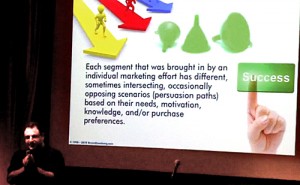
Look out Austinites! There’s a new kid in town. Renown marketing consultant, Jeffrey Eisenberg, author of multiple books (listed below), web analytics specialist, professional speaker, and conversion king is relocating to Austin, Texas. I met Jeffrey last week at the local SEO Meetup after watching his presentation: 21 Secrets of Top Converting Websites. He’s a down to earth guy that really understands the personas of people who buy online; a great addition to the marketing community of Austin.
Eisenberg started the presentation talking about website conversions. Many people mistakenly think the term conversion, when used with regard to websites, always means buying something online. But a conversion can also be something as simple as clicking a video, entering an email address, or filling out a survey. In other words, it’s an action. Sometimes it’s the first and most important action in building the relationship before the sale, a.k.a. Lead Generation. Below is the Eisenberg brothers’ definition of conversion rate:
“Conversion rate is a measure of your ability to persuade visitors to take the action you want them to take. It’s a reflection of your effectiveness and customer satisfaction. For you to achieve your goals, visitors must first achieve theirs.”
Here are the 21 secrets of top converting websites that Eisenberg discusses at length in his presentation.
Jeffrey says, “when you build a site or redesign a site, you are about 30% done. The real work is in the optimization, not in the site. Everybody does that ass-backwards. EXCEPT for some people [Amazon] who now control 25% of the ecommerce market. [Companies that decided] we’re not ever going to stop redesigning, we’re not ever going to stop thinking about the experience.”
“We take those funds that might otherwise be used to shout about our service, and put those funds instead into improving the service. That’s the philosophy we’ve taken from the beginning. If you do build a great experience, customers will tell each other about that. Word of mouth is very powerful.” ~ Jeff Bezos, founder of Amazon.com
Jeffrey and his brother Bryan have written many best selling books. Here are three that come to mind: Waiting For Your Cat To Bark:Persuading Customers When They Ignore Marketing, Call To Action: Secret Formulas to Improve Online Results, and Persuasive Online Copywriting: How To Take Your Words To The Bank.
P.S. Austin is a cool town and it’s easy to see why Jeffrey would want to move here: high tech, music, tex mex, healthy economy, etc… But at the Meetup I discovered the real reason he moved to Austin; it was for love. Thanks Mia!
This month’s Austin Social Media Club featured a panel of nonprofit movers and shakers who answered questions from David Neff (another local nonprofit rock star) about how they utilize social media within their organizations. Although the topics vary from month to month, I noticed from the first club meeting I attended that social media for social good is always an underlying theme. Sure, people want to grow their businesses and grow their networks using social media, but using social media tools to facilitate a call to action, is what Austin Social Media Club does best. Whether you’re talking about @ConnieReece and The Frozen Pea Fund, or @MikeChapman and Mobile Loaves & Fishes, @MichelleGreer and the hugely successful Austin Charity Water Twestival or @daveiam and Lights. Camera.Help., it’s all about making a difference.
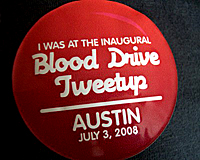
I mean, it’s really not all that surprising that my first Tweetup was a Bleedup! I gave blood for the first time in my life, summer of 2008, due to Michelle Greer and David Neff’s persistent tweeting. Their efforts helped the local blood bank double their supplies before the busy fourth of July weekend. [click to continue…]
Recently, Qualman spoke about Socialnomics at the Book Expo America convention, the largest book publishing event in North America. Here’s a video clip from his BEA 2009 presentation in May where he shares some interesting facts about Wiki’s and Facebook.
The fastest growing segment on Facebook is 55-65 year-old females
People find this statistic shocking, but I don’t. Most women are natural communicators and networkers, so it makes perfect sense. And you can be sure that these numbers are accurate coming from within Facebook. See the entire article from InsideFacebook.com for more facts and graphs about Facebook users.
The rest of the stats seen in the video, along with their sources, are in the book and can be seen here on the blog: Socialnomics.net. All statistics have inherent bias and are rarely exact, but they are often an excellent way to capture a trend or movement. Here’s one example; By 2010 Gen Y will outnumber Baby Boomers….96% of them have joined a social network. The source for this was from Grunwald Associates National Study and highlighted on Trendsspotting Blog. They did a national study and sampled 1,277 kids from age 9-17. The results stated that 96% of online teens/tweens report ever having used any type of social networking technology including IM/chat, text messaging and email. Reporting “96% of them“, instead of “96% of online Gen Y users” is a bit deceptive, although there is no denying that this trend is still very impressive.
I haven’t read the book yet, but I am really looking forward to it, despite the statistical wiggle room. I have read some awesome reviews and hear that it’s filled with valuable case studies and real world examples of how businesses are utilizing social media. Here’s a link to the Buzz About Socialnomics page.
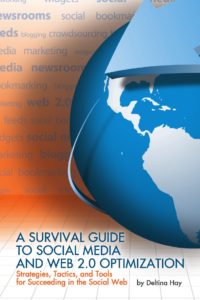
I met Deltina Hay at her book signing and talk on the Social Web at BookPeople this past July. I really enjoyed her presentation and how openly and honestly she spoke about her writing process for this intensive project. NOTE: Video below shows some excerpts from Deltina’s presentation.
Most people are well aware of the term SEO (Search Engine Optimization), but many haven’t heard of and/or don’t understand SMO (Social Media Optimization). Deltina talks about the Social Web and explains why interacting, collaborating and sharing is vital to your social media online presence. The book is extremely detailed and perfect for anyone who is ready to take their social media understanding to the next level. It is an instructional textbook that even includes a companion cd with forms and resources to help you get both organized and optimized. Here is a downloadable pdf containing Chapter Seven complete with forms.
I have been actively studying social media tools and strategies since 2007, so most of the book’s content is not new to me. That said, I am quite sure I will use this book weekly, not only as a handy reference guide, but also at a consultant’s companion. Much of what I do is about empowering and educating others so they can understand and better utilize social media in their businesses. I work with all levels and much of my time is spent explaining concepts, tools, and strategies. I have already started recommending this book to my clients. For a sneak peek you can check out chapter seven in it’s entirety, as supplied by Dalton Publishing below. Social Media Book Teaser
After listening to Deltina I’ve decided that she is a definitely a SMOP (social media optimized personality) and she is running two very successful SMOBs (social media optimized business) here in Austin, Texas; Social Media Power and Dalton Publishing. Hint: One of the best ways to learn about social media optimization is to study what other SMOBs and SMOPs are doing. Following Deltina on twitter is one place to start. @SocialMediaPWR
This book will not only help you survive, it will help you thrive in the Web 2.o world. If you are new to social media, this survival guide will undoubtedly save you time and anguish. And if you are an advanced Web 2.0 user, it will help you flesh out a solid strategy to harness your own social media power. And the added bonus is, when you are really busy and your friends keep asking you social media questions like “What’s an RSS feed?” etc…, you can just hand them the book and say, “Chapter 3!”
Now, please excuse me, I have to go tweet this, write a review on amazon.com, add this book to my LibraryThing and my reading list on Linkedin, and double check that my RSS feeds are successfully filtering this post to my facebook page and subscribers. Perhaps I’ll even add an image of this book cover with a link to this book review to my Social Media Therapist Flickr account! It’s all about being an authentic SMOP after all.
___________________________________________________
If you want to support indie publishing and get a discounted price, click the Buy Now button below, or the publisher’s link above. Dalton Publishing offers an affiliate program discount so that everybody wins. More dollars go directly to the independent publisher, you save a few dollars, and I even make a buck or two! :) Of course it is your choice, get the book at your local book store, at Amazon.com, or buy it right here for $18.95 including shipping!
I have a good friend who thinks Google is going to take over the world, and not in a good way. Whenever she brings up the subject my mind quickly fills with images from the Terminator movies. Machines take control and mankind as we know it is doomed. I know where she’s coming from, regarding privacy, etc… but I have nothing to hide, so I’m not afraid of Google. In fact, I’m pro-Google. I use gmail, Google docs, and I LOVE having a Google profile.
Google Profiles are relatively new, but I’ve had mine since last year when I first discovered the beta feature while browsing around my google account. In fact, when I first created mine I was really frustrated because it wasn’t even googlable yet. But that all changed this past spring when Google freed the search engines robots, Googlebots, so they could read and access google profiles.
What I recommend is that you purchase a domain of your name, or something close, and have it forward to your Google profile. For example, on my business card I list just one url: SueRostvold.com. It’s perfect because it directs people to all my links, as well as a brief description of the services I offer. Instead of trying to tell someone what your twitter handle is or to look you up on Linkedin, just send them to yourname.com!
Just like your Linkedin profile, your Google profile will show up on the first page when someone does a search of your name. Not only is it empowering to take control of how you are viewed online, it can also raise the ranking of your blog and other social networking channels. And finally, having a complete and impressive Google profile is a great way to show off your technical and social media savviness to your clients or perspective employers.
Found a fantastic little video that helped me better understand Google, SEO and Thesis.
Web designers can make some killer looking sites. And there is no shortage of free templates, that look awesome, to help you build your website. But what I didn’t understand until recently is that Google doesn’t like the cool code that makes up the cool design. Google likes clean and simple html. If you have some wild and crazy design code mixed in with the html code that makes up your content, ie your text, then Google has a hard time figuring out what your website is about. The Google robots get confused and give up. They may find and record some of your content, but they don’t do a thorough job. Then your ranking suffers. You don’t get found.
No matter what you are using now, it’s never too late to get started with Thesis.(I can help if you like!)After all, Thesis is the most innovative and user-friendly SEO-Optimized Wordpress framework on the planet!
I love simple websites. While in the middle of a making a website transition a couple years ago, a friend recommended Don’t Make Me Think – A Common Sense Approach to Web Usabilityby Steve Krug. I found it incredibly useful. Steve gets straight to the point, and even throws in a bit of humor while telling you what you really need to know. It’s a must read for web designers and anyone who has a website. Don’t Make Me Think goes beyond web design and explains web usability, something many designers forget to consider. You want your website to look good, but more importantly, you want people to easily find their way around, i.e. don’t make them think!
In his book Steve says, “In the past five years I’ve spent a lot of time watching people use the Web, and the thing that has struck me most is the difference between how we think people use Web sites and how they actually use them.”
One of the more interesting parts of the book is how Steve explains with diagrams and details how we navigate around a website.
We don’t read pages. We scan them.
Some people get so hung up on design, that they forget about the goal of their website. You want your visitors to stay, to read, to click and ultimately to spend money. But also, you want your customers to be satisfied, interact, tell their friends, get valuable content, write excellent reviews, and come back again and again.
That’s why having a site that makes sense and is easy to navigate is so crucial. Sure, SEO is important, it’s what gets traffic to your site. But when you finally get them to land on your website, you want to keep them there and keep them happy. If they get frustrated, you may lose them forever. [click to continue…]
“I’m just going to get a free blog from Wordpress.com. I mean, why pay for something when you can get it for free?” I’ve heard this more than once, and it makes me crazy. I’m sure that sometimes people think I’m trying to get them to hire me when I explain why a free Wordpress blog doesn’t always make sense. I’m not. I just like to share information, especially when I think it can keep them from major headaches later on. (I know. I ‘ve had this headache.)
When someone says they have a free blog at Wordpress.com, what they mean is, they have free web hosting. Wordpress.com is hosting the site for them at no charge. They are supplying both the application, (Wordpress is built into the site), and the web server. Web hosting is a service that companies provide to help you keep track of and store all the files for your website. Everything on the internet needs to have a home on some computer somewhere. When you hear people talk about their web server, they are talking about the physical computer or computers that their web host uses to store all the files that make up their website.
When you sign up with a web hosting company, like Bluehost.com, then you have access to all the files that make up your blog. The guts of your website, you know, the html, css, php, and all those other crazy coded files that don’t make much sense until you need them.
TERMS
1.Sorry, We’re Closed – WHAT IF they decided they aren’t going to host blogs anymore? This happened recently with Yahoo.com/Geocities. They told everyone that had a free hosted blog that they needed to move it, lose it, or buy your own domain and pay for hosting through them. Many people lost all their links and had to start from square one again.
Need a website? Well it’s never been easier! One option is to hire someone to set up a site for you, have them spend a couple hours teaching you the basics, and then you are well on your way. Below are some beginning steps to ensure a great start. [click to continue…]
This morning I turned on the radio in my car to hear one of my favorite Eagles’ songs, New Kid In Town. I had a very nostalgic little drive to my neighborhood grocery store. This song came out in 1978, the same year I graduated from high school.
On my way back from the store what I didn’t expect to hear was “Tweet to Win!”. K-Geezer (a.k.a. 107.1 KGSR Radio Austin) engaging their listeners on twitter? I guess I don’t listen to the radio enough to realize it’s becoming the norm. I decided to do a search, and sure enough, I found a site that lists radio stations on twitter.
New Media and radio seem like a natural fit in many ways. When you think about traditional advertising, (Radio-Television-Newspaper), it’s clear who has had the edge all along. In fact, radio perhaps was the very first form of social media marketing using technology. They have been engaging with their listeners since the very beginning. I’m not saying they did it well, but they were getting feedback and engaging none the less, even way back in the early days of radio.
So it’s come to this. Tweet-to-win. Instead of caller #7, it’s Direct Message #7 on twitter who gets the JD Souther at Threadgills tickets!
Well, it worked. They got me. I came home and started following @KGSR. I plan on trying to win some tickets with DM’s too. Way to start twittering KGSR! I’d love to see you incorporate some non-profit fund raisers into your twitter strategy as well. You have the twitter power now, use it for good!
FYI: In 1978 the Eagles received two Grammy awards: Best Vocal Arrangement for “New Kid In Town” and Record of the Year for Hotel California. Ahhh… the memories.